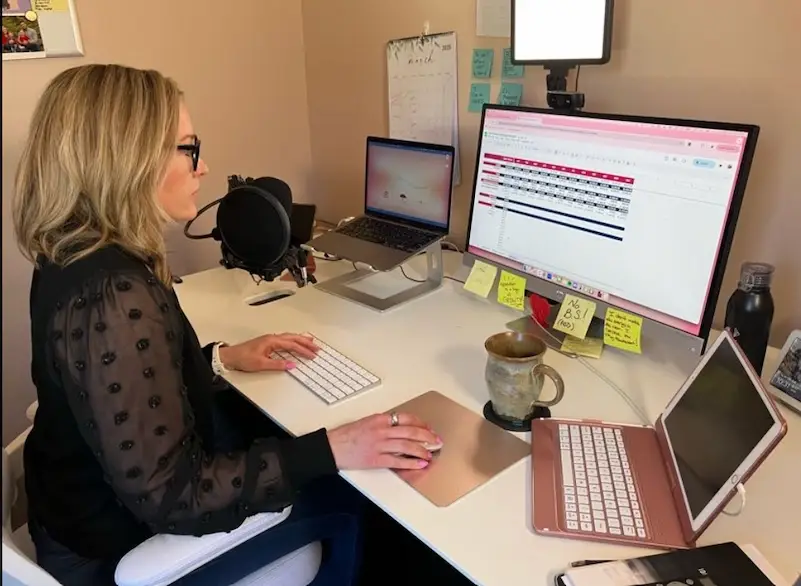

There have been plenty of times throughout my entrepreneurial journey when I’ve questioned whether I was giving too much of myself to my business.
Am I working too much? Am I spending enough time with my family? Should I be putting this much energy into growing something? Is wanting more for my business a good thing, or am I getting caught up in chasing success?
And then, of course, there’s the other side of that conversation.
When I’m spending time with my family, there’s often something in the business that needs attention. When I’m working, I can think of a dozen things I could be doing at home.
Sound familiar?
If you’re a Christian entrepreneur, or even someone considering starting a business, you may have wrestled with some version of these questions.
We want to use our gifts, create opportunities, provide for our families, and build something meaningful. But we also want to honor God, be present for the people we love, and make sure our ambitions aren’t pulling us away from what matters most.
So, is building a business selfish?
I don’t believe it is. But I do believe it’s a question worth exploring.
Because the answer has less to do with whether we own a business and more to do with why we’re building it, how we’re building it, and what we’re allowing it to cost us.
Why Do We Feel Guilty About Wanting to Build Something?

I think part of the struggle comes from the expectations we place on ourselves.
We want to be good spouses, parents, friends, business owners, and people of faith. We want to show up for everyone, do our work well, and somehow have enough energy left at the end of the day to enjoy our lives.
And when one area requires more attention than another, guilt tends to show up. I’ve experienced this in my own life.
There have been seasons when my business required more of me than I anticipated. I’ve worked late, made difficult decisions, and carried responsibilities that weren’t always easy to set aside when the workday ended.
I’ve also experienced the opposite. I’ve stepped away from work to be with my family, only to catch myself thinking about everything waiting for me when I returned.
It’s easy to interpret that tension as evidence that we’re doing something wrong. But I’ve learned that feeling guilty and actually neglecting something aren’t always the same thing.
Sometimes guilt is an important signal. Maybe we’ve taken on too much. Maybe our priorities have shifted without us realizing it. Maybe a relationship or responsibility genuinely needs more attention.
Other times, guilt comes from believing we should be able to do everything, for everyone, all the time. And that’s simply not realistic.
Instead of immediately assuming our ambition is the problem, I think it’s worth asking where the guilt is coming from and whether it’s pointing us toward something we actually need to change.
What Does the Bible Say About Work, Ambition, and Stewardship?
One of the things I love about my faith is that it continually challenges me to look beyond what I’m accomplishing and examine the heart behind it.
The Bible speaks about work, responsibility, serving others, and using the gifts we’ve been given.
Colossians 3:23 encourages us to work wholeheartedly, as working for the Lord.
First Peter 4:10 reminds us to use our gifts to serve others as faithful stewards of God’s grace.
And Proverbs 16:3 calls us to commit our work to the Lord.
None of these passages promises that following God will lead to business success. And I certainly don’t believe everyone is called to entrepreneurship.
But I do believe that running a business can be one way we use the abilities, opportunities, and resources God has entrusted to us.
Think about what a healthy business can do.
It can provide for a family. It can create employment opportunities. It can solve problems for customers. It can support a community. It can give someone the flexibility to care for people they love.
Those things matter!
At the same time, stewardship isn’t simply about producing more or building something bigger.
It’s also about how we manage our time, our money, our relationships, and our responsibilities.
A business can be profitable and still be unhealthy. It can be growing while the person running it is exhausted, disconnected, or constantly sacrificing things they say are important.
That’s why I think the conversation about faith and business needs to go deeper than whether ambition itself is good or bad.
The question is whether we’re being responsible with what we’ve been given.
And that includes the business, but it also includes everything outside of it.
Is It Ambition, or Is It Ego?
Okay, this is where I have to challenge myself a little because I genuinely love building businesses.
I love strategy. I love technology. I love solving problems, developing systems, creating new opportunities, and seeing an idea turn into something real.
Give me a messy process and a few hours to figure out how to make it work better, and I’m a happy girl.
But just because I enjoy building something doesn’t mean every opportunity deserves my attention.
And just because I can do something doesn’t mean I should.
That’s an important distinction I’ve had to learn over the years.
As entrepreneurs, we’re surrounded by messages telling us to grow, scale, expand, launch, and accomplish more. There’s always another opportunity. Another strategy. Another person doing something that makes us wonder whether we’re falling behind.
And before we know it, we can find ourselves chasing goals we haven’t stopped to question.
I’ve had to ask myself whether I’m pursuing something because it genuinely serves the direction I want to go, or because I like the feeling of accomplishing it.
Those are two very different motivations.
There’s nothing inherently wrong with wanting to grow a successful business or earn a good living.
But when our identity becomes wrapped up in how much we earn, how many clients we have, or how impressive our businesses look to other people, it’s probably time to examine what we’re pursuing.
Luke 12:15 reminds us that life doesn’t consist in the abundance of our possessions. That’s a good reminder for those of us who love setting goals and checking things off a list. Our accomplishments matter, but they aren’t the measure of our worth.
So when you’re considering a new opportunity, I encourage you to ask yourself a few questions.
Why do I want this?
Who will it serve?
What will it require of me?
Am I pursuing it because it’s right for this season, or because I feel pressure to keep growing?
And perhaps most importantly, am I willing to change direction if I realize the cost is greater than I want to pay?
I don’t think those questions make us less ambitious. I think they help us become more intentional about what we’re building.
The Reality of Balancing Business, Family, and Faith

Can we talk about balance for a minute? Because I think we’ve made it sound like there’s some magical schedule where every part of our lives receives exactly the right amount of attention, every single day. (If someone has figured that out, please let me know).
In my experience, life doesn’t work that way.
There are weeks when the business needs more attention. There are weeks when family responsibilities take priority. There are seasons when we’re growing, seasons when we’re maintaining, and seasons when simply getting through what’s in front of us is enough.
And sometimes life changes our plans entirely. Earlier this year, I unexpectedly lost my dad. It was an incredibly difficult season for my family, and it changed what I was able to give my businesses. There were things I simply couldn’t be involved in the way I normally would.
But something happened during that time that reminded me why I’d spent so many years working to build better systems and develop my team.
My business kept running. My team continued serving our clients, making decisions, and handling responsibilities while I was away.
Was everything perfect? Of course not. But the business didn’t require me to be involved in every single decision to keep moving. And I found something really meaningful in that.
For years, I’ve talked about building a business that doesn’t depend entirely on its owner. I’ve worked on documenting processes, delegating responsibilities, and learning to trust the people around me.
And during a season when my family needed me, I experienced the value of that work in a way I never could have anticipated.
It reminded me that building a healthy business isn’t only about what it can accomplish when we’re working. It’s also about whether it can support us when life requires our attention somewhere else.
I don’t share that because I think every entrepreneur needs to build a large team or create a business that runs completely without them. I share it because I think we sometimes forget that the decisions we’re making in our businesses today affect the lives we’re able to live tomorrow. And that is absolutely a conversation about stewardship.
Building a Business That Supports What Matters Most
One of the things I’ve become increasingly convinced of is that we need to stop treating business growth as the automatic answer to every challenge.
Sometimes the answer isn’t another client, another offer, another software subscription, or another person on the team. Sometimes we need to make better decisions about what we’re already doing.
If we’re serious about building businesses that honor our faith and responsibilities, we have to look at how we’re actually running them.
Here are a few areas I think deserve our attention.
Define What Success Looks Like for You

It’s easy to borrow someone else’s definition of success.
Maybe it’s hitting a certain revenue goal, building a large team, expanding into new markets, or having the freedom to travel whenever you want. Those can all be worthwhile goals. But what if success in your current season looks different?
- Maybe it means having enough flexibility to attend your children’s activities.
- Maybe it means building a profitable business without working every evening.
- Maybe it means creating jobs for other people.
- Or maybe it means maintaining what you’ve already built instead of constantly pursuing the next level.
Your goals should reflect the responsibilities, opportunities, and priorities in your life, not simply what looks impressive online.
Be Honest About Your Capacity
We can have the best intentions in the world and still take on more than we can reasonably manage.
I’ve done it.
When we continually say yes to new commitments without considering what they require, something eventually gets squeezed.
Sometimes it’s our rest. Sometimes it’s our family. Sometimes it’s the quality of our work.
Learning to recognize our capacity isn’t a lack of ambition.
It’s part of responsible leadership.
Build Systems That Give You Room to Live
(You knew I was going to bring up systems eventually.)
But seriously, I believe this is one of the most practical things business owners can do.
When everything lives in your head, your business needs you for everything.
Every client question, follow-up, decision, and recurring task becomes another thing you have to remember.
Documenting processes, using the right tools, delegating responsibilities, and creating better workflows can help reduce that dependency.
And no, you don’t need a complicated technology stack or a 47-page standard operating procedure for every task.
Start by identifying the things that repeatedly require your attention and ask whether there’s a better way to handle them.
The goal isn’t to automate every part of your business.
It’s to create enough structure that your business doesn’t consume every available moment of your life.
Make Room to Listen, Not Just Do
This one can be especially difficult for those of us who are naturally driven.
We like action. We like solving problems. We like making progress.
But when we’re constantly moving from one responsibility to the next, we can lose the space to reflect on whether we’re even heading in the right direction.
Prayer, quiet time, reflection, and seeking wise counsel are important parts of how I approach decisions.
Not because I always receive some immediate, perfectly clear answer. I don’t.
But because slowing down gives me the opportunity to examine my motives, consider my responsibilities, and make decisions more thoughtfully.
Sometimes we need to stop asking how to accomplish more and start asking whether the things we’re pursuing still make sense.
Give Yourself Permission to Reevaluate
Something I’ve learned over the years is that a goal can be right for one season and no longer be right for another.
That doesn’t necessarily mean the original goal was a mistake.
It may simply mean something has changed.
Your family may need something different from you. Your business may have evolved. Your interests, capacity, or responsibilities may have shifted.
You are allowed to acknowledge those changes.
You can adjust your schedule, change an offer, restructure your business, slow down, or pursue a new direction. And you can do those things without assuming you’ve failed.
Sometimes responsible stewardship means continuing to build. Other times, it means recognizing when something needs to change.
Maybe We’re Asking the Wrong Question
So, is building a business selfish?
I don’t believe owning a business, wanting to grow, or pursuing professional success is inherently selfish. But I also don’t believe that every ambition becomes good simply because we attach faith to it.
We have to be willing to examine our motives, consider the people affected by our decisions, and acknowledge when something isn’t working. Maybe instead of asking whether it’s selfish to build a business, we should be asking:
- Am I using my gifts and opportunities responsibly?
- Am I serving people well?
- Am I honoring the relationships and responsibilities God has entrusted to me?
- Am I building something that supports the life I want to live, or am I allowing the business to determine how I live?
- And am I willing to make changes when I recognize that something needs my attention?
I believe we can love Jesus, love our families, and genuinely love the work we’re doing. We don’t need to apologize for having ideas, enjoying our work, or wanting to create something meaningful. But we also don’t need to prove our worth through constant growth and achievement.
There will be seasons when we push forward and seasons when we pull back. Times when we need to work hard and times when we need to let someone else carry something.
That’s part of life.
The goal isn’t to build a business that allows us to do everything. It’s to build one that helps us be faithful with what matters most.
And sometimes, the most important business decision we can make is recognizing that there’s more to our lives than the businesses we’re building.
Building a business while staying grounded in your faith, family, and personal priorities isn’t always easy.
And sometimes, you just need a little encouragement, a fresh perspective, or a reminder that you’re not the only one figuring it out as you go.
That’s exactly why I created The Sunday CEO.
It’s a space for entrepreneurs who want to grow their businesses with purpose, lead with intention, and keep what matters most at the center of it all.
If you’re ready for a little more inspiration and encouragement in your entrepreneurial journey, I’d love to have you join us.
AMAZON AFFILIATE
Jennifer Sakowski is a participant in the Amazon Services LLC Associates Program, an affiliate advertising program designed to provide a means for sites to earn advertising fees by advertising and linking to Amazon.com.