
If you’re a Christian solopreneur trying to serve powerfully, honor God, grow your income, answer emails, post content, invoice clients, and still be present for your family — and you feel like you’re barely holding it together…
Hear me.
You don’t need more discipline. You need simple small business systems Christian entrepreneurs can actually sustain.
Overwhelm is not a spiritual gift, chaos is not proof you’re called, and exhaustion is not a badge of obedience.
Somewhere along the way, faith-driven entrepreneurs started believing that if God called you, it should just “flow.” But calling without structure creates burnout. Vision without systems creates stress.
So let’s settle this right now.
What basic systems should a faith-based entrepreneur have to stay sane and sustainable?
At minimum, you need five things: a clear client onboarding process, a simple way to track your money, a weekly rhythm you can repeat, defined communication expectations, and personal capacity boundaries you actually honor.
That’s it.
Not 47 apps.
Not a color-coded corporate dashboard.
Not hustle disguised as holiness.
Just aligned structure that supports your calling.
When you don’t have business systems for Christian entrepreneurs in place, you live in reaction mode. You wake up checking messages. You spend your day putting out fires. You end your week wondering why you worked so hard but still feel behind.
That’s not a faith problem. That’s a systems problem. And the good news? Systems can be built.
You are not disorganized because you lack faith. You’re overwhelmed because you’ve been carrying everything in your head. It’s time to build structure that matches your calling.
Business owner, but surrendered.
Organized, but Spirit-led.
Strategic and obedient.
Let’s do this the right way.
Why Structure Matters, Especially in Faith-Driven Business

Somewhere along the way, many Christian entrepreneurs absorbed this subtle belief: “if God called me to it, it should just flow.”
But Scripture shows us something different.
Creation had order. The temple had measurements. Instructions were specific. God is intentional. Structure is not a lack of faith. Structure is stewardship.
When your backend is messy, your mind stays cluttered. You forget follow-ups. You dread your inbox. You avoid your finances. You operate from pressure instead of peace and when you operate from pressure, discernment gets cloudy.
Entrepreneur systems organization Christian leaders need isn’t about control. It’s about clarity.
Simple systems reduce decision fatigue so you can hear God more clearly. They create consistency so your business stops depending on your adrenaline.
If you haven’t yet built your business plans on aligned foundations, it’s a good idea to start there first. Now let’s get practical.
5 Essential Systems Every Faith-Driven Entrepreneur Needs
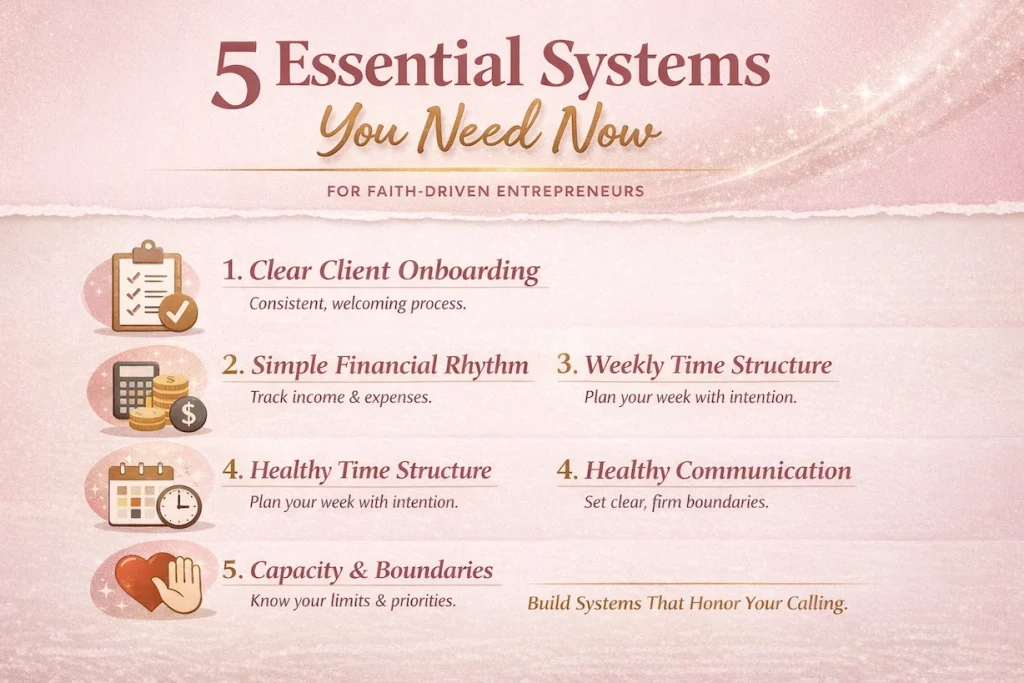
You don’t need complexity. You need five core systems done simply and consistently.
1. A Clear Client Onboarding System
If onboarding feels different every time, it’s draining more energy long term than you realize.
When someone says yes to working with you, there should be a repeatable flow. They receive the same welcome email. The same contract process. The same expectations. The same payment instructions.
Without this, you start every client relationship scrambling.
You can purchase tools to automate pieces of this, but you don’t need something fancy. Even a simple checklist in Google Docs works.
Remember: the goal is clarity.
Implementing This in a Faith-Respecting Way
Set expectations with kindness and firmness. Include communication windows. Define scope clearly. Make it clear how and when you respond.
This isn’t about being rigid. It’s about discipling your clients into honoring structure.
Structure is not unloving. It’s protective.
2. A Simple Financial Rhythm
Many Christian entrepreneurs either avoid their numbers or feel uncomfortable caring about them.
But stewardship requires visibility.
You don’t need complicated accounting dashboards. You need a monthly review habit. A simple income and expense tracker. A tax savings plan.
Tools like QuickBooks or Wave can help, but a spreadsheet is perfectly fine.
The system isn’t the software.
The system is the rhythm.
Implementing This in a Faith-Respecting Way
Set aside 15 minutes each week to review your numbers. Pray over your business. Ask for wisdom. Celebrate provision.
When you look at your finances consistently, fear loses its grip.
And fear is what makes money feel heavy.
Weekly Time Structure
Overwhelm often isn’t about too much work.
It’s about no rhythm.
If every day looks different, your brain never settles. You wake up wondering what’s urgent instead of knowing what’s important.
A simple weekly rhythm might look like dedicating one day to CEO planning, a few days to client work, and one block for admin and finances.
You can use Google Calendar or Notion, but again — the tool is secondary. The structure is primary.
Implementing This in a Faith-Respecting Way
Build margin into your calendar to have a positive impact.
Schedule prayer. Protect rest. Honor Sabbath. If your schedule reflects constant urgency, your nervous system will mirror it.
Small biz workflow tips faith based entrepreneurs need most begin with honoring limits.
Jesus withdrew regularly. You’re allowed to as well.
A Communication System That Protects Your Energy
If your inbox dictates your mood, you don’t have a communication system.
You have reactivity.
A simple system might mean checking email at designated times instead of all day. It might mean having templated responses for common questions. It might mean not using DMs as your primary client channel.
Tools like Gmail can support this, but the real system is expectation management.
Implementing This in a Faith-Respecting Way
Communicate clearly how and when you respond.
Boundaries are not unkind.
They are clarity in action.
You are not called to be constantly available. That role is already filled.
5. A Personal Capacity & Boundary System
This is the one most faith-driven entrepreneurs ignore.
You need to know your limits before you hit them.
What is your maximum client load? What are your work hours? What is a non-negotiable family night? What projects are simply not aligned with your assignment?
Write these down.
Review them monthly.
Before saying yes, pause long enough to evaluate whether you actually have margin.
Implementing This in a Faith-Respecting Way
Faithfulness is obedience, not availability.
Overcommitment is often spiritualized ambition.
When you protect your capacity, you protect your longevity.
And longevity matters in the Kingdom. Trust God.
Signs You Don’t Have Systems (Even If You Think You Do)

Many faith-driven entrepreneurs believe they have systems simply because they have tools. But tools are not systems.
A calendar isn’t a rhythm. An invoicing app isn’t a financial plan. An inbox isn’t a communication strategy.
If you’re honest, you might recognize some subtle warning signs. You rewrite the same email repeatedly instead of creating a template. You avoid logging into your bank account because it feels stressful.
You feel occasional resentment toward clients but can’t pinpoint why. You say yes quickly and regret it later. You work during family time “just this once” — and somehow it happens every week. You start Monday already feeling behind.
Those aren’t character flaws. They’re indicators that your business is running on memory instead of structure.
When there is no documented process, everything lives in your head. And when everything lives in your head, your brain never fully rests. Even during dinner. Even at church. Even on vacation.
You’re mentally tracking invoices, remembering follow-ups, replaying conversations, and trying not to drop anything important. That constant internal tab-keeping is exhausting.
Christian entrepreneurs are especially vulnerable to this because we care deeply. We want to serve well. We want to be available. We want to be generous. But generosity without guardrails eventually turns into depletion.
A real system answers the question before it becomes emotional. Instead of wondering, “Should I respond right now?” your system says, “I answer emails at 11 and 4.”
Instead of wrestling with, “Can I take this client?” your system asks, “Do they fit my criteria?” your system reminds you, “My capacity is four active clients.” Instead of panicking, “Where did the money go?” your system grounds you in, “I review finances every Friday.”
Peace often comes from pre-decisions. And pre-decisions are simply systems you chose ahead of time.
This is where many Christian business owners get stuck — not because they lack faith, but because they’ve confused spontaneity with surrender. Being Spirit-led does not mean being structure-less.
In fact, when your foundational systems are steady, you create more room for discernment. You’re no longer making decisions from urgency or pressure. You’re making them from alignment.
And alignment feels different. It feels calm. It feels clear. It feels sustainable.
If your business currently depends on your adrenaline, your memory, and your constant availability, that’s not a calling issue. It’s an infrastructure issue. And infrastructure can be rebuilt — one simple, faithful system at a time.
Tech & Tools vs. Heart-Led Boundaries

There’s a misconception that more automation equals more peace.
You can automate everything with tools like ClickUp and Raney Day Connect and still feel exhausted.
Automation handles repetition, however it doesn’t fix misalignment.
The purpose of business systems for Christian entrepreneurs isn’t to maximize output at all costs. It’s to create sustainability.
You need both systems and discernment.
Automation can streamline your workflow. Boundaries protect your soul.
If you want hands-on support implementing business systems for Christian entrepreneurs without compromising your values, explore my coaching and consulting services here: https://jennifersakowski.com/coaching/
Structure should feel freeing — not suffocating.
Build Your First System Portfolio
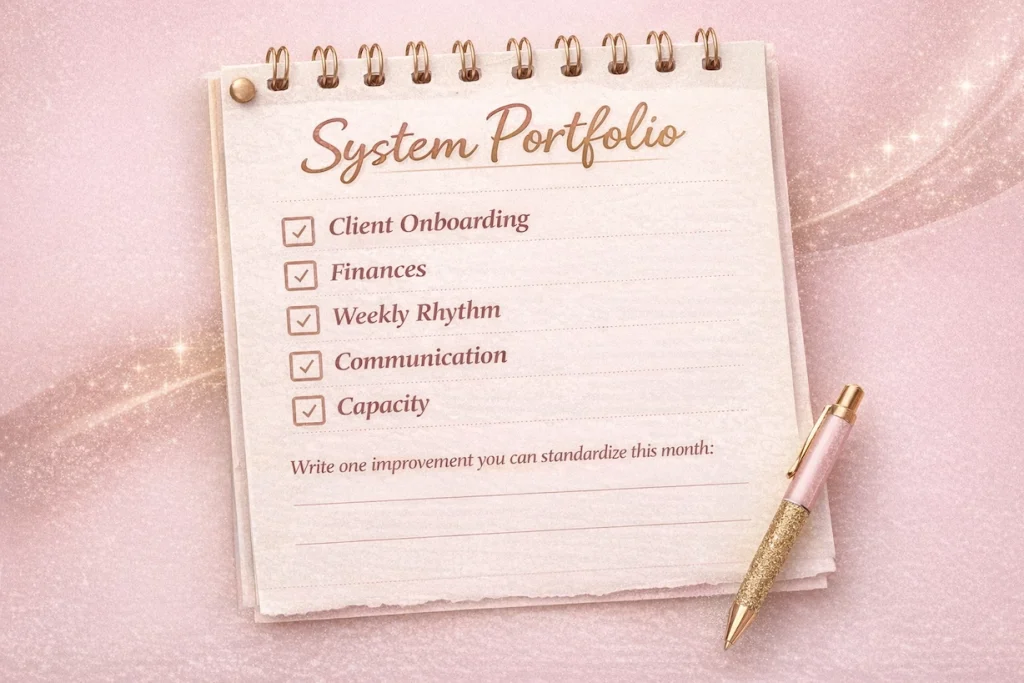
Instead of trying to fix everything this week, start with a simple “system portfolio.”
Open a notebook or spreadsheet and create five sections:
- Client Onboarding
- Finances
- Weekly Rhythm
- Communication
- Capacity
Under each, write one improvement you can standardize this month.
Just one.
One template.
One recurring calendar block.
One financial review habit.
One communication boundary.
One capacity rule.
This is how you build entrepreneur systems organization Christian leaders can trust. Slowly. Intentionally. Prayerfully.
If you’re overwhelmed right now, remember: you are not scattered because you lack faith. You are scattered because you’ve been carrying everything in your head.
Clarity reduces anxiety. Structure reduces mental noise. Systems protect your calling.
The enemy loves fog. God brings order. And sometimes order looks like a simple checklist.
You don’t need corporate complexity. You need simple small business systems Christian entrepreneurs can maintain — systems that support your faith, protect your family, and sustain your impact.
And if you’re ready to build those systems with guidance, accountability, and biblical alignment, I’d be honored to walk with you.